
Research
Distinguished Senior Assistant Professor (Principal Investigator)
Yohei Kawana, M.D., Ph.D.

Research Fields
Diabetes, Metabolism, and Endocrinology
Research Subject
Elucidation of inter-organ neural networks that promote pancreatic β-cell proliferation
Development of therapeutic strategies to expand pancreatic β-cell mass
Academic Memberships
Japan Diabetes Society,
Japan Society for the Study of Obesity,
Japan Endocrine Society
Research Outline
My goal is to contribute to understanding the pathophysiology of diabetes and obesity and to establish novel therapeutic approaches.
Pancreatic β-cells are indispensable for glucose homeostasis. By secreting insulin, they facilitate glucose uptake into cells and suppress meal- or stress-induced elevations in blood glucose levels. However, in patients with diabetes (both type 1 and type 2), β-cell mass is reduced or depleted. Thus, uncovering the mechanisms that drive β-cell proliferation could pave the way for curative treatments for diabetes.
During weight gain, pancreactic β-cells undergo compensatory proliferation, increasing insulin secretion to maintain normal glucose levels. Our research group previously discovered an “inter-organ neural network” (highlighted in red in the figure below), wherein obesity-induced changes in the liver transmit signals via afferent nerves to the brain, which then relay signals through efferent nerves to the pancreatic islets, thereby stimulating β-cell proliferation [1, 2]. Building on this concept, I focused on the vagus nerve, the key autonomic pathway linking the brain and pancreatic islets. We successfully achieved endogenous β-cell proliferation by direct stimulation of the vagus nerve using optogenetics (highlighted in blue in the figure below) [3].
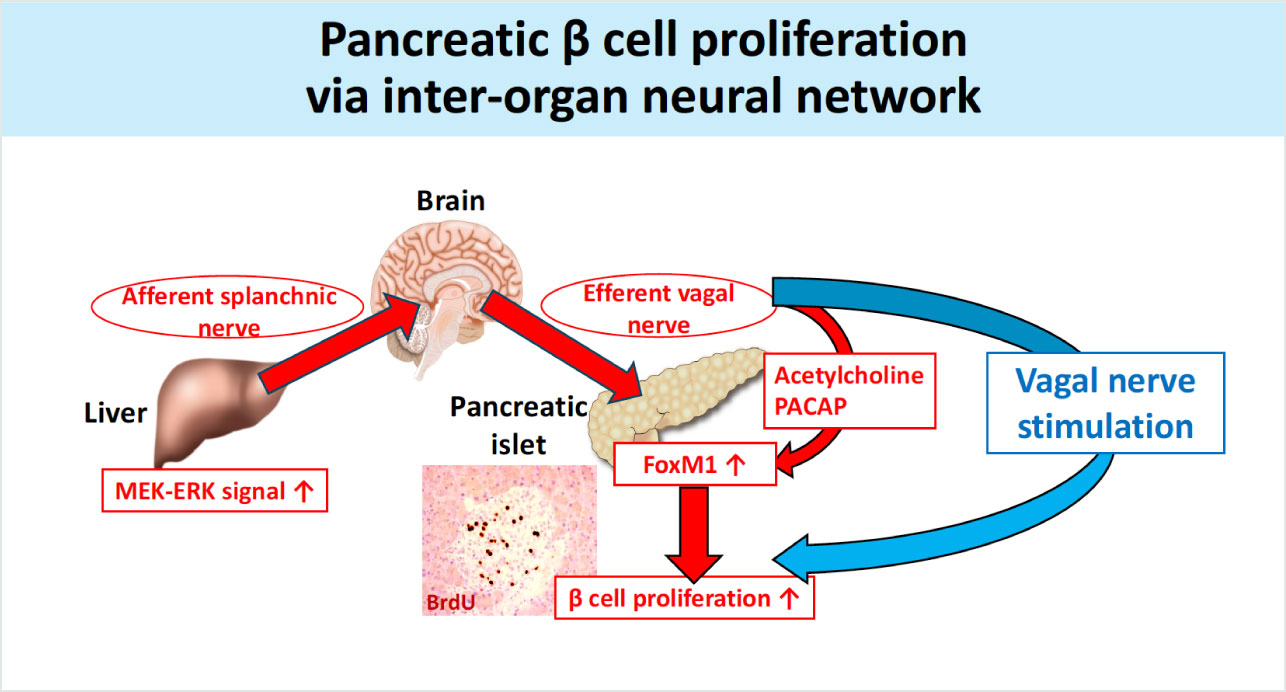
Currently, I am investigating how the brain processes liver-derived signals and transmits them to the vagus nerve, as well as how vagal signaling activates β-cell proliferation within pancreatic islets. In parallel, I am developing vagus nerve–based therapies to enhance β-cell mass.
References:
- Imai et al. Regulation of pancreatic beta cell mass by neuronal signals from the liver. Science. 2008 Nov 21;322(5905):1250-4. doi: 10.1126/science.1163971.
- Yamamoto et al. Neuronal signals regulate obesity induced β-cell proliferation by FoxM1 dependent mechanism. Nat Commun. . 2017 Dec 5;8(1):1930. doi: 10.1038/s41467-017-01869-7.
- Kawana et al. Optogenetic stimulation of vagal nerves for enhanced glucose-stimulated insulin secretion and β cell proliferation. Nat Biomed Eng. 2024 Jul;8(7):808-822. doi: 10.1038/s41551-023-01113-2.